Skincare and beauty should be tested first.
The best entry point is not "fashion content." It is a premium retention and education surface for founder-led skincare and beauty brands: lifecycle emails, replenishment logic, routine education, and a simple executive dashboard that shows whether trust is compounding.
Segment: Skincare / beauty, especially science-backed, founder-led, premium independent brands.
Existing offer mapping: Lifecycle Engine + Visual Intelligence Engine, with Brand Continuity Package as the strategic wrapper. Newsletter Automation Engine is proof of editorial delivery, not proof of triggered ecommerce retention.
Single-line offer to test: We turn claims, proof, and replenishment timing into a premium lifecycle system that makes trust visible before the next purchase moment.
This is no longer only a segment memo; it is now a demand-validation brief.
The outside critique was right: the original study was disciplined about segment selection, but too thin on observed demand and too detached from the work iHD is already running. This upgrade keeps the skincare/beauty recommendation, but lowers confidence until three missing proofs are collected: audience language, actual lifecycle teardowns, and paid-buyer response.
Validation upgrade The memo now separates hiring-budget proxy from willingness to buy, names the in-housing risk, and makes the paid pilot the only promotion mechanism.
iHD synthesis No skincare founder has yet paid iHD for a Klaviyo-style triggered lifecycle system. Existing proof comes from editorial newsletter automation and premium creative systems.
Validation upgrade Five brand-specific lifecycle teardowns, ten targeted outreach messages, three buyer calls, and one paid 30-day pilot before any infrastructure build.
| Critique | Upgrade made | Decision effect |
|---|---|---|
| Trend layer looked like hypothesis naming, not demand evidence. | Added live channel interpretation: TikTok/social commerce and Pinterest visual search are now separate source categories rather than buried under generic trend language. | Skincare stays first, but the rationale shifts from "jobs exist" to "education, proof, bundles, and routine language convert in the channel where beauty demand forms." |
| Job postings can indicate in-housing, not outsourcing demand. | Added a buyer-risk section: lifecycle/CRM hiring is evidence of pain and budget, but it may reduce willingness to buy a vendor unless the offer clearly augments the internal hire. | iHD should sell a 30-day external diagnostic and team-as-a-service layer, not generic "we run your emails." |
| Existing proof is in the wrong email modality. | Moved offer fit from Newsletter Automation Engine to Lifecycle Engine, while naming the proof gap around triggered ecommerce flows. | The pilot must be priced and scoped as a proof-building bridge, not presented as fully validated ecommerce retention capability. |
| The memo skipped sequencing against the live gallery cycle. | Added a sequencing rule: do not run skincare in parallel with galleries unless it is a bounded evidence sprint. | Gallery cycle remains the operating focus; skincare becomes a two-week validation sprint or a deliberate swap, not a second full lane. |
Ranked segment x offer hypotheses
| Rank | Segment x offer pair | Existing offer map | Taste 25% |
Founder-light 25% |
Unit econ 20% |
Cold repeat 15% |
Leverage 10% |
Budget 5% |
Score |
|---|---|---|---|---|---|---|---|---|---|
| 1 | Skincare / beauty retention and routine education Best wedge: premium lifecycle system for repeat purchase, routine onboarding, subscription or replenishment, and proof-led content. |
Lifecycle Engine + Visual Intelligence Engine + Brand Continuity Package | 5 | 4 | 5 | 4 | 5 | 4 | 91 |
| 2 | Beauty cinematic launches as a secondary wedge Useful as a door opener, but weaker than retention because competitors can copy content faster than systems. |
Cinematic Reel Engine + Brand Continuity Package | 5 | 3 | 4 | 4 | 4 | 4 | 80 |
| 3 | Luxury / premium fashion clienteling intelligence Best wedge: visual CRM/clienteling reports, VIP communication calendar, and sales-associate usable product storytelling. |
Brand Continuity Package + Visual Intelligence Engine + Newsletter Automation Engine | 5 | 3 | 4 | 2 | 4 | 5 | 75 |
| 4 | Sustainable fashion product-data storytelling Real market pressure, but iHD should not sell compliance or verification. Only sell the presentation layer on verified/supplied data. |
Visual Intelligence Engine + Brand Continuity Package | 4 | 2 | 3 | 3 | 3 | 4 | 61 |
Scores are normalized from the assignment rubric: Taste advantage/pricing power 25%, founder-dependency 25%, unit economics 20%, cold acquisition repeatability 15%, existing-offer leverage 10%, buyer budget 5%. Each cell is scored 0-5.
Skincare / beauty: strongest fit
Founder-led or science-backed skincare/beauty brands with repeat-purchase products, education-heavy claims, and a CRM/lifecycle gap. Best buyer titles: founder/CEO, Chief Marketing & Growth Officer, Head of Retention, Lifecycle/CRM Manager, ecommerce lead.
The customer journey depends on trust: what to use, when to refill, why the claim is credible, and how the routine fits the customer's problem. The pain is not "make emails"; it is translating product truth into repeatable communication that does not cheapen the brand.
Communication surface: yes, very strong. Operational/information surface: yes, because routine cadence, replenishment, churn, subscription, and education adoption can be made visible without enterprise-grade risk.
"from lead gen and welcome to replenishment and win-back"
| Signal | Weight | What it says | Use in decision |
|---|---|---|---|
| KraveBeauty Retention & CRM Manager | High: independent demand signal | Operator role owns lifecycle programs and repeat purchase at a values-driven skincare brand. | Confirms buyer-side budget and role ownership for exactly the kind of system iHD can package. |
| Dr. Idriss Senior Manager, Lifecycle, Loyalty + Subscription | High: independent demand signal | Evidence-based skincare brand hiring around lifecycle, loyalty, and subscription. | Shows that science-led skincare needs a bridge between education, retention, and recurring revenue. |
| Skin + Me CRM Lead | High: independent demand signal | CRM owner responsible for retention, LTV, engagement, triggered programs, and churn reduction across subscription brands. | Validates the operational dashboard portion: churn, LTV, replenishment, triggered journeys. |
| YOCTO / Forge / Pixeltree / Chronos competitor set | Medium: competitor map | Competitors explicitly sell beauty/skincare lifecycle, Klaviyo, subscription, replenishment, and routine education. | The market exists, but most positioning is technical-performance. iHD can differentiate on taste, trust, and editorial clarity. |
The next proof is not more generic research. It is channel language plus brand-specific lifecycle evidence.
The strongest correction from the feedback is that beauty demand forms in TikTok/social commerce and Pinterest visual search before it appears as a clean B2B services brief. iHD should use those channels to understand audience language, then validate willingness to pay through five concrete email lifecycle teardowns.
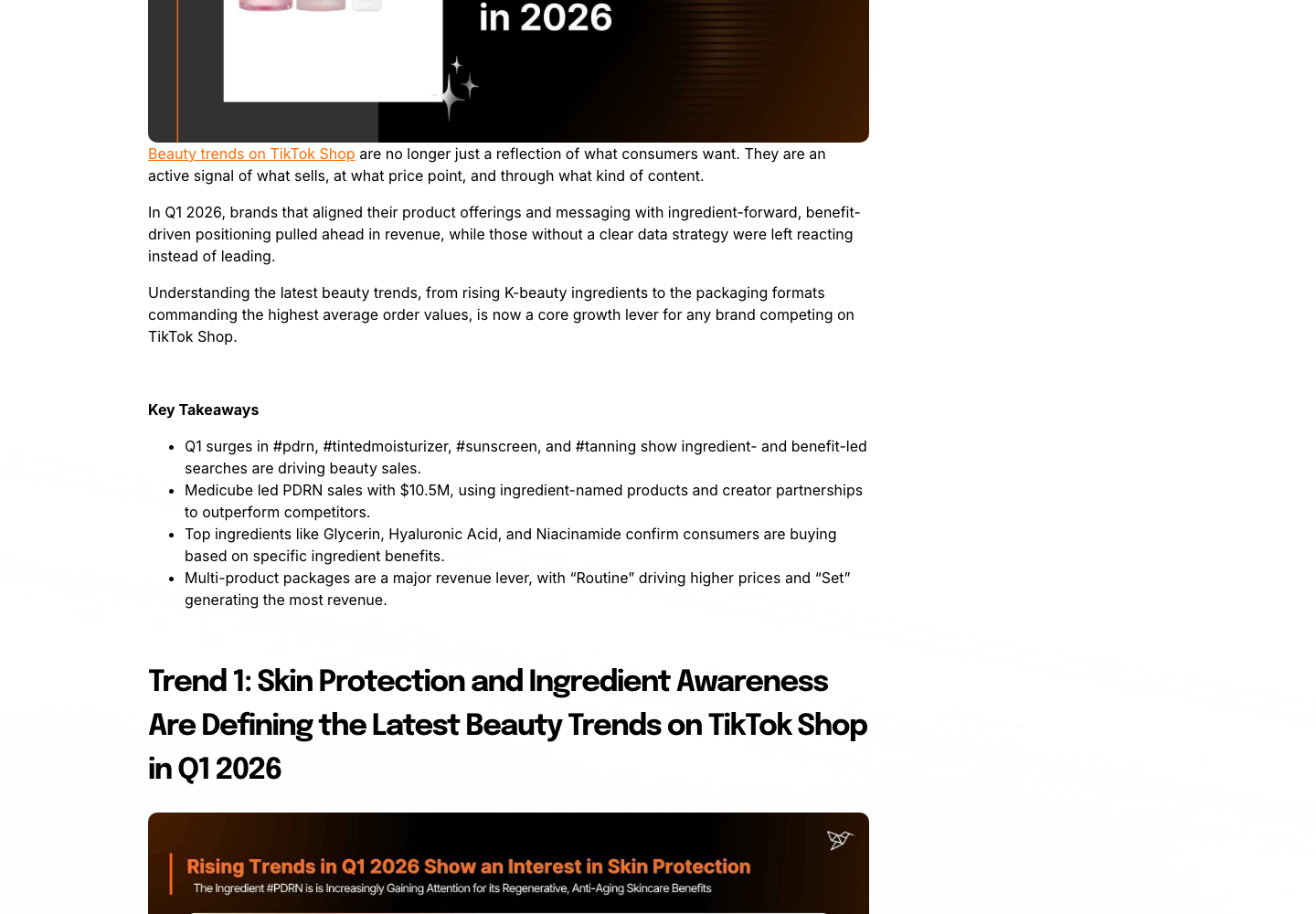
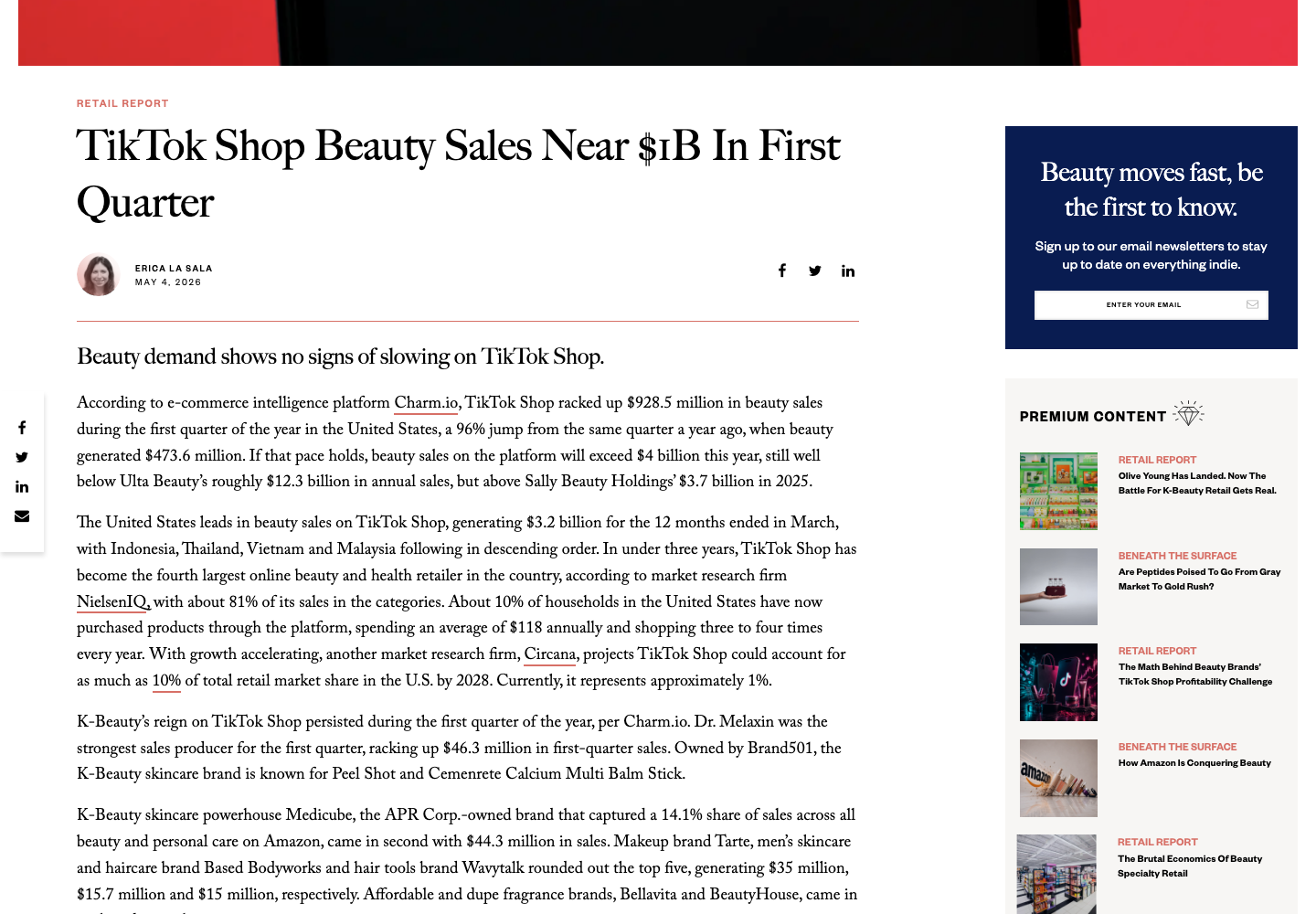
TikTok Exa-surfaced Q1 2026 TikTok Shop analyses show skincare demand clustered around ingredient education, visible efficacy, bundles, and creator demonstrations. This supports proof-led lifecycle education, not generic content calendars.
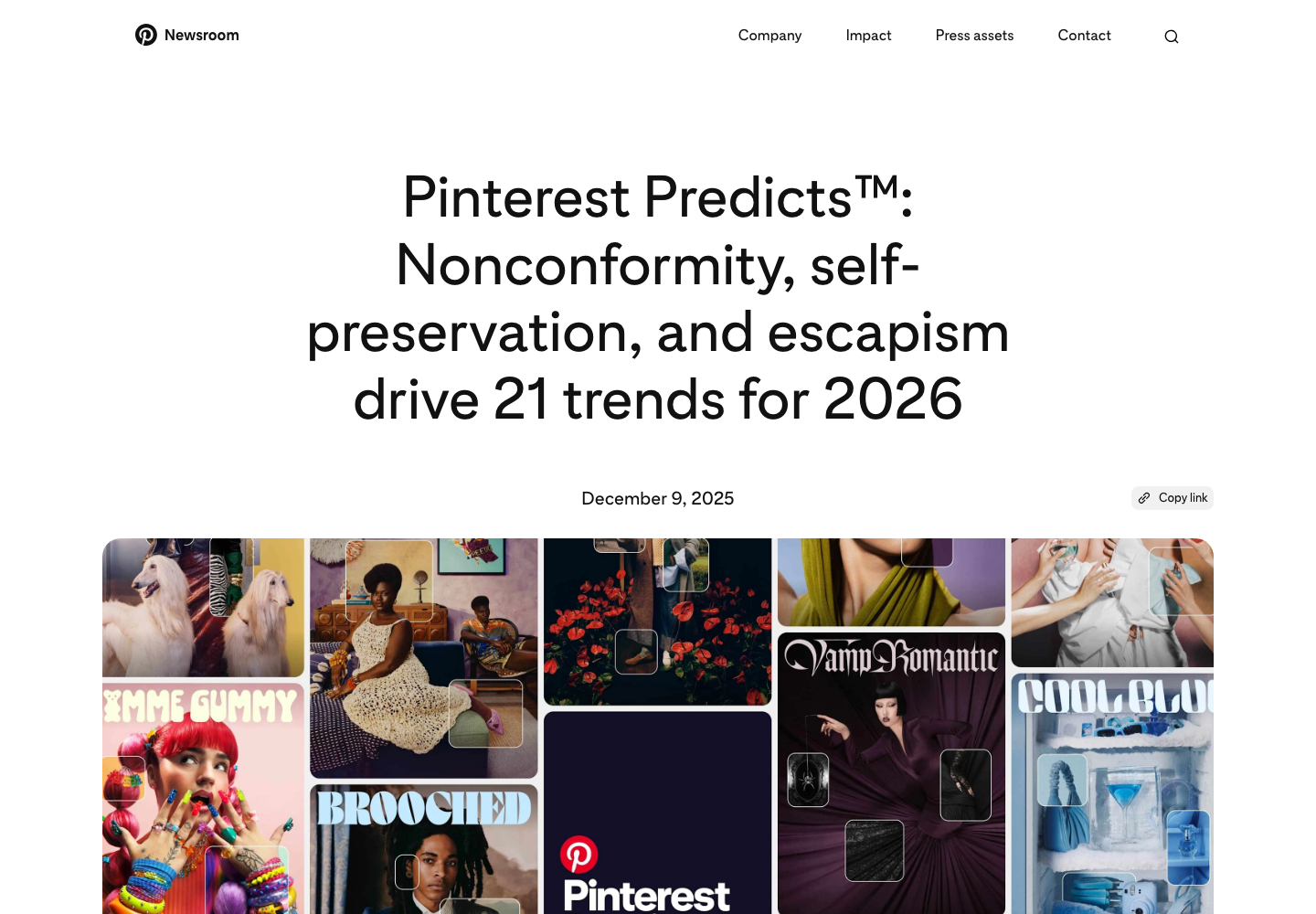
Pinterest Pinterest Predicts 2026 is useful for aesthetic and seasonal language: beauty/fashion trends such as Vamp Romantic, Glitchy Glam, Scent Stacking, Glamoratti, Poetcore, Laced Up, and Cool Blue can inform campaign language and visual direction.
Validation upgrade The buyer test must be concrete: audit actual lifecycle flows for target brands, write the outreach around one observed gap, and ask for a paid 30-day pilot.
| Evidence or gap | What it changes | How iHD should act |
|---|---|---|
| TikTok Beauty/skincare social commerce rewards ingredient education, visible result language, value/bundle framing, and creator demonstrations. | The offer should not start as "we make newsletters." It should start as "we turn your proof, claims, and routine timing into lifecycle moments that customers understand before repurchase." | Build teardown templates around claim clarity, ingredient education, replenishment timing, bundle logic, and proof assets that can travel from TikTok into email/SMS. |
| Pinterest Pinterest is less about immediate conversion and more about aesthetic planning, trend fatigue, visual self-expression, seasonal search, and campaign mood. | Use it to sharpen visual positioning and calendar timing, not to prove B2B budget. | Add Pinterest as a low-cost trend capture layer for beauty/fashion campaign angles, especially when proposing visual trust and launch systems. |
| Exa.ai CRM/lifecycle job postings show budget and organizational priority, but also imply in-housing. | Hiring evidence is not equal to vendor demand. A brand hiring a CRM lead may need enablement, audit, dashboards, teardown, migration, or overflow support rather than an outsourced agency. | Position iHD as a premium external diagnostic and taste/proof layer that helps the internal lifecycle owner move faster without cheapening the brand. |
| iHD synthesis Current proof comes from editorial newsletter automation and premium creative systems, not delivered ecommerce triggered-flow case studies. | The segment fit is attractive, but the proof basis is borrowed from an adjacent email modality. | Sell the first pilot as a proof-building engagement: audit, flow map, creative proof rules, first implementation recommendations, and founder-readable dashboard. |
Validation upgrade Run this before building anything: subscribe to Topicals, Dieux, Experiment, KraveBeauty, and Rhode; capture welcome, abandoned-cart, post-purchase, education, replenishment, win-back, and promotion flows for 14 days; then produce one specific outreach note per brand. Success is not "we found insights." Success is one paid 30-day pilot or a clear refusal pattern from qualified buyers.
Validation upgrade Do not run skincare as a full second lane while the gallery cycle is still producing client-to-operator and cold-churn data. Either keep galleries as the main operating cycle and run skincare as a tightly bounded two-week validation sprint, or consciously swap vertical focus after the gallery read is complete.
Luxury fashion: attractive, but harder to enter cold
Premium contemporary and luxury-adjacent brands with meaningful DTC, store openings, VIP customers, or wholesale-to-DTC transition. Avoid LVMH-scale enterprise as a first wedge; target brands big enough to have customer data pain but small enough to buy a premium pilot.
Luxury fashion is hiring around CRM, clienteling, client data quality, and personalized outreach. The strongest pain is not public content volume; it is how to maintain intimacy across ecommerce, retail, VIP events, and sales-associate communication.
Communication surface: yes. Operational/information surface: yes, but sales cycles and incumbent platforms are heavier. iHD should test a visual clienteling/reporting layer before proposing software.
"transform data insights into targeted outreach strategies"
| Signal | Weight | What it says | Use in decision |
|---|---|---|---|
| Celine Head of CRM & Clienteling, North America | High: independent demand signal | Regional CRM/clienteling strategy, recruitment, retention, engagement, and client culture. | Confirms luxury budget, but enterprise scale implies slow entry for iHD. |
| Givenchy Senior Manager CRM Analytics & Client Experience | High: independent demand signal | Role connects data insight, boutique leadership, outreach, and fashion-advisor briefings. | Confirms the operational surface: client data must become usable retail action. |
| Fendi CRM Director / Tiffany CRM expert / Dunhill Global Client & CRM Manager | High: independent demand signals | Lifecycle, clienteling, CRM communications, VIC events, gifting, trunk shows, and scalable clienteling. | Signals budget and pain, but also mature incumbents and procurement friction. |
| BSPK, Clientbook, Tulip, Endear, Salesfloor, Peridot | Medium: competitor map | Platforms and agencies promise unified data, associate tasking, personalized outreach, visual curation, and performance measurement. | iHD should not compete as a platform. Test a boutique intelligence/design layer that makes existing data and calendar decisions legible. |
| Telegram Internal Telegram fashion archive | Low/secondary: internal local signal | Repeated local commentary that premiumization, loyalty, ecommerce, and looking more expensive matter in fashion retail. | Useful context, not a primary proof source. It supports the direction but does not replace buyer outreach. |
Sustainable fashion: real pressure, risky offer boundary
Sustainable, premium, or export-facing fashion brands that need to make product data, material stories, certificates, and impact claims readable to customers and internal teams.
DPP and traceability pressure is real. But the hard problem is verified data: supplier declarations, materials, certificates, LCA fields, provenance, and compliance. That is not iHD's natural first product.
Communication surface: yes, if data is supplied and verified elsewhere. Operational/information surface: limited. iHD can design a readiness dashboard or passport narrative, not certify claims.
"turn unstructured product information into structured, compliant data"
| Signal | Weight | What it says | Use in decision |
|---|---|---|---|
| PVH sustainability technology / traceability roles | High: independent demand signal | Enterprise roles around systems, traceability, certification technology, supplier data, and consumer experience. | Confirms budget and operational pain, but also high liability and technical depth. |
| Textile Exchange / assurance and traceability roles | High: independent ecosystem signal | Standards and assurance work are professionalizing around traceability. | Shows the category is moving toward verification and data governance, not just storytelling. |
| Renoon, Carbonfact, Avelero, Traceable Digital, GreenStitch, TextilePass, Wetrack | Medium/low: competitor and vendor map | Platforms sell DPP generation, product data foundations, LCA, supplier/certificate data, QR passports, and compliance readiness. | iHD should position around clarity and premium presentation on top of these tools, not against them. |
| Telegram Internal Telegram archive: eco-claim skepticism | Low/secondary: internal local signal | Local fashion commentary repeatedly flags weak or performative sustainability claims. | Supports caution: do not sell green claims unless the data is real. |
14-day real-buyer test
The study is not done until buyers behave. The next move is a paid-pilot test with a minimum premium floor around $3,800/month, not a survey and not a free audit.
Hypothesis A - skincare retention surface
Offer line: We turn claims, proof, and replenishment timing into a premium lifecycle system that makes trust visible before the next purchase moment.
Success metric: 3+ qualified buyer replies, 2+ calls booked, and at least 1 buyer willing to discuss a paid 30-day pilot at or above $3,800/month.
Hypothesis B - luxury clienteling intelligence
Offer line: We make your clienteling, VIP calendar, and product-story data usable for ecommerce, store teams, and founder-level decisions without replacing your CRM.
Success metric: 2+ CRM/client development leaders agree to a live diagnostic call and share one current workflow artifact or pain point.
Hypothesis C - sustainable product-data storytelling
Offer line: We turn supplied product, material, and certificate data into a premium customer-facing transparency surface and internal readiness view, without making verification claims.
Success metric: 2+ brands or DPP vendors ask for a co-sell conversation or paid prototype; otherwise park this segment.
Named reachable lead list
Trend signals sharpen copy, but do not validate demand
A reusable trend and anti-trend signal layer was added after this study. Its first skincare validation run did not change the segment ranking, but it did sharpen the offer language toward proof-led lifecycle education.
Typed records for category trajectory, anti-trend positioning, audience questions, platform locus, creator density, site density, and Reddit/community pain. Every record carries source, geo, method, weight, use, and caveat.
The anti-trend module ranked proof-led as the strongest positioning hypothesis against "AI skincare." Audience language to test includes "repair my skin barrier," "damaged skin barrier," "simple routine," "product overload," and "barrier-first."
Trend records are upstream and low-weight. They may rewrite outreach and annotate the scorecard, but they cannot promote a hypothesis without the named 14-day buyer test.
| Signal | Weight | What it says | Use in decision |
|---|---|---|---|
| Trend layer Proof-led anti-trend vs. AI skincare | Medium for positioning, low for demand | Counter-position survives as a copy/positioning hypothesis: claims, proof, and usage cadence should be made visible. | Changed the skincare outreach line from generic product education to proof-led lifecycle education. |
| Trend layer Skin barrier and routine simplification language | Medium for copy, not demand | Seeded validation language clusters around barrier repair, damaged skin, simple routines, skin cycling, and product overload. | Use in first outreach variants and lifecycle content examples; replace fixture with live Google/Pinterest capture before citing externally. |
| Trend layer Access status | Low operational note | Google Trends SerpApi, Ahrefs, YouTube API, Reddit OAuth, and Pinterest API are not configured in this local run. | Keep these signals as internal hypothesis-generation until API or manual browser captures are attached. |
Google Trends shows which fashion-retail pains are gaining search intent
Google Search/Trends belongs in this kind of research because it answers a different question from Exa or EchoThread: not "who is hiring or talking about this," but "what pain language do buyers and operators actively search when they are trying to solve a problem?"
Search-intent direction, seasonality, pain-language discovery, and cross-pain comparison across 10 to 15 years. It is especially useful for sizing whether a phrase is operator language or just analyst/vendor language.
It does not prove budget, urgency, or willingness to buy from iHD. It should shape the problem map and outreach copy, then be checked against buyer conversations and named pilots.
Google Search and the Google Trends homepage responded. The direct Trends endpoint first returned HTTP 429, but a temporary pytrends client with a compatible HTTP stack successfully fetched US monthly Google Trends data on June 20, 2026.
Google Trends Real US monthly Google Trends data was fetched with pytrends on June 20, 2026. These are 0-100 interest indexes, not absolute search volumes. Each panel is normalized within its own five-term comparison, so use the chart for direction and pain-language patterns, not market sizing across panels.
- Dead stock is the clearest inventory-pain search signal: its latest 12-month average is far above 2011, while supporting operational terms such as sell-through and markdown optimization remain smaller but visible.
- Fit/returns pain is dominated by size-chart behavior. Virtual try-on is present but still much smaller than basic fit-information search language.
- Visual commerce has become a materially stronger search field, with product photos/product photography high and AI fashion-model/product-photography terms appearing as newer solution searches.
- Retention language is stronger than fashion-specific CRM language: loyalty program and customer retention dwarf clienteling/fashion CRM as search phrases.
- DPP/product-passport search interest is no longer zero, but it remains a compliance/education signal rather than proof that iHD should build a traceability platform.
| Fastest-rising term in this pull | 2011 avg | Latest 12mo avg | Index change | % change |
|---|---|---|---|---|
| product photos | 4.2 | 67.1 | +62.8 | 1478% |
| dead stock | 14.8 | 69.5 | +54.8 | 371% |
| loyalty program | 15.6 | 68.8 | +53.2 | 341% |
| product photography | 11.4 | 57.1 | +45.7 | 400% |
| size chart | 43.5 | 75.1 | +31.6 | 73% |
| sustainable fashion | 1.2 | 31.4 | +30.2 | 2593% |
| product passport | 0.8 | 28.6 | +27.8 | n/a |
| customer retention | 5.4 | 32.1 | +26.7 | 492% |
| AI fashion model | 0.0 | 13.7 | +13.7 | n/a |
| retail inventory management | 1.1 | 12.9 | +11.8 | 1092% |
| Pain cluster to graph | Search terms | What rising interest would mean | How iHD should use it |
|---|---|---|---|
| Google Trends Inventory cash pressure | retail inventory management; dead stock; overstock inventory; sell through rate; markdown optimization | More founders and operators are searching for cash-preservation and assortment-control answers, not just growth marketing help. | Prioritize the Inventory Cash-Flow War Room and make markdown timing, SKU age, and buying capacity visible in the offer. |
| Google Trends Returns and fit trust | product returns; how to reduce returns; size chart; fit finder; virtual try on | Fit uncertainty and returns remain buyer-facing symptoms that fashion retailers may pay to reduce. | Connect Visual Trust QA to returns reduction, not only to content quality. |
| Google Trends AI visual production | AI product photography; AI fashion model; product photography; ecommerce photos; product photos | Retailers may be searching for cheaper image production, but the strategic risk is trust degradation and brand inconsistency. | Frame iHD as premium visual governance: taste rules, proof requirements, and SKU-level QA around AI-assisted content. |
| Google Trends Clienteling and retention | clienteling; fashion CRM; retail CRM; customer retention; loyalty program | If clienteling and CRM language rises, fashion buyers may be moving from traffic acquisition toward repeat purchase and personal selling systems. | Use the skincare lifecycle thesis as a fashion CRM/clienteling offer, but only after a buyer test with premium boutiques or independent luxury brands. |
| Google Trends Traceability and DPP | digital product passport; fashion traceability; product passport; supply chain transparency; sustainable fashion | A rising DPP/search-compliance curve would support a productized education and data-readiness service, not a full compliance platform. | Keep sustainability as a specialist-adjacent content/data layer unless search interest plus buyer outreach shows urgent budget. |
I have general web search access and can open Google Search result pages, but I do not currently have a working Google search-volume tool such as Keyword Planner or Search Console. For this graph, I used Google Trends via pytrends, which returned monthly US interest-index data. Treat the chart as search-intent direction, not absolute search volume.
Fashion pain is real, but the best products are operational
EchoThread changes the fashion read from "make better fashion content" to "compress the decisions that trap cash, dilute taste, and make customer learning disappear." The corpus supports startup and productized-service ideas, but most are operational intelligence products rather than pure creative retainers.
Canonical EchoThread SQLite corpus validated on June 20, 2026: 61,056 videos, 61,315 transcripts, 14,626 podcast episodes, 11,050 podcast transcripts, 1,428,490 transcript chunks, and 98,122 recovered chunks.
Fashion-retail profile, inventory/merchandising/cash-flow profile, curated fashion evidence packs, source index, and the corrected research-agent handover. Recovered chunks are valid for SQL research but not yet fully embedded.
This does not demote skincare as the first iHD test. It creates a second, stronger fashion thesis: paid pilots should target inventory, merchandising, retail learning, and visual trust systems.
| Pain pattern | Productized service or startup idea | Evidence source type | Use in decision |
|---|---|---|---|
| Inventory becomes frozen cash. Operators overbuy, delay markdowns, misread sell-through, and discover too late that old inventory is not just clutter but trapped future buying power. |
Inventory Cash-Flow War Room. A weekly dashboard/service that turns SKU age, sell-through, markdown timing, and buying capacity into founder-readable decisions. |
EchoThread Fashion evidence pack: inventory management, dead stock, cash-flow, inventory-attachment, and boutique old-inventory sources. | Best fashion startup wedge. It has recurring pain, measurable ROI, and a clear buyer: owner, merchandiser, buyer, or operations lead. |
| Retail learning disappears after the event. Pop-ups and stores reveal fit, fabric, pricing, location, and customer-language signals, but teams rarely convert those observations into reusable launch or assortment decisions. |
Pop-Up Learning Loop. A lightweight app/service for logging try-on objections, fitting-room comments, location performance, and staff observations after each event. |
EchoThread Operator interviews: founder-led store openings, pop-up testing, customer listening, location, and foot-traffic learning. | Good iHD-adjacent pilot because it can combine forms, dashboards, editorial summaries, and founder-ready recommendations. |
| Visual trust is fragile. Cheap-looking product photos, inconsistent fit/fabric cues, and AI-looking visuals can damage premium trust even when they reduce content cost. |
Visual Trust QA for Fashion SKUs. A SKU-level review that flags missing proof: fit angles, fabric closeups, scale, color confidence, styling context, AI-risk, and product-page objections. |
EchoThread Fashion/beauty sources: product photography, AI fashion, product-photo tutorials, visual trust, and premium-brand content evidence. | Strong bridge to iHD's Visual Intelligence Engine. The offer must be framed as conversion/trust QA, not generic content production. |
| Founder taste becomes a bottleneck. Taste protects the brand early, but later it can slow approvals, confuse teams, and keep campaign, product, and retail decisions trapped in the founder's head. |
Founder Taste Operating System. A service that converts founder taste into approval rubrics, campaign rules, product-story templates, and visual decision standards. |
EchoThread Fashion/operator sources: founder identity, key-person risk, creative advice, burnout, brand-building, and team-decision evidence.
I had been driving pretty much every part of the business creatively and strategicallyEchoThread / podcast transcript, chunk 23: Lucy Henry-Hicks Made $90 Million In the Fashion Business Last Year. the brand is Dish the brand isn't LucyEchoThread / podcast transcript, chunk 25: Lucy Henry-Hicks / Dissh founder interview. we trust each other to make the best decisions for the brandEchoThread / podcast transcript, chunk 2: Why Going DTC Isn't as Simple as Putting Your Inventory Online. If you are not at your best, your business will never operate at its best.EchoThread / podcast transcript, chunk 0: Your Burnout Is Costing Your Brand More Than You Think. |
Premium service opportunity, but harder to sell cold because buyers may not admit the bottleneck. Use as an upsell after a diagnostic. |
| DTC channels are brittle. Brands depend on Shopify, Instagram, creators, ads, email, and community, but a hacked ad account or weak community loop can expose the fragility of growth. |
Community CRM Resilience Map. A diagnostic that maps owned audience, creator seeding, email capture, replenishment, customer trust, and channel-risk fallback paths. |
EchoThread DTC/operator sources: Shopify, organic growth, influencer gifting, ads fragility, community trust, lifecycle, and email evidence. | Useful as a productized audit. It can feed skincare retention work and fashion CRM work without becoming a generic ads agency offer. |
Ranked product and productized-service attractiveness.
iHD synthesis The score below weights four things: credible path to $50,000/month in recurring revenue, strength of buyer pain, fit with iHD's visual/editorial intelligence strengths, and whether the offer has enough creative edge to avoid becoming a commodity agency service.
| Rank | Idea | Score | Best form | Commercial read |
|---|---|---|---|---|
| 1 | Visual Trust QA for Fashion SKUs. | 91 | Productized service, then SaaS-lite workflow. | Best iHD-native wedge: visual, editorial, conversion-oriented, and easy to demonstrate with before/after evidence. A $50k/month path is plausible with 8-15 retained brands if packaged as conversion trust QA rather than generic content critique. |
| 2 | Community CRM Resilience Map. | 86 | Productized audit plus monthly lifecycle service. | Strongest recurring-revenue machine because CRM, email, replenishment, community, and creator seeding naturally become monthly work. It is less visually glamorous, but commercially durable and directly useful for skincare and fashion operators. |
| 3 | Inventory Cash-Flow War Room. | 82 | High-ticket retail intelligence service with dashboard layer. | Very real pain with measurable ROI: sell-through, markdown timing, SKU age, and cash trapped in old inventory. The caveat is positioning. It becomes compelling for iHD only when framed as founder-readable retail intelligence, not inventory software. |
| 4 | Founder Taste Operating System. | 78 | Premium strategy service and diagnostic upsell. | Most distinctive and most Arseni-coded: taste, standards, founder judgment, decision systems, and creative operating doctrine. Harder to sell cold because the buyer may not admit the bottleneck. Best introduced after a visual trust or retail intelligence diagnostic reveals the pattern. |
| 5 | Pop-Up Learning Loop. | 70 | Lightweight app/service, or feature inside Retail Intelligence Memo. | Useful and elegant, but narrower as a standalone business because many retailers run pop-ups irregularly. Stronger as a module: capture store, trunk-show, market, and pop-up learning, then convert it into assortment, product-page, and clienteling decisions. |
Decision read: lead with Visual Trust QA, attach CRM Resilience where recurring revenue matters, use Inventory War Room for ROI-led fashion operators, and keep Founder Taste Operating System as the premium second sale. Pop-Up Learning Loop should become a feature unless a specific event-heavy client segment emerges.
Exa.ai is strongest for current web evidence: jobs, vendors, people, agencies, and source discovery. EchoThread is stronger for recurring operator language and second-order pain: what retailers learn too late, what founders repeat across interviews, and where operational decisions become startup opportunities.
Run one focused evidence export from the canonical DB for each candidate above, then use Gemini CLI or NotebookLM only on that exported pack for clustering and contradiction analysis. Do not use semantic-only retrieval until recovered chunks receive embeddings.
Two offers worth packaging before selling
The research points to two sellable packages, but they should not be described as generic marketing services. The language has to make the buyer feel that iHD understands the actual failure mode: trust does not compound, product value is not visible enough, and customer learning disappears before it becomes a repeatable operating asset.
Proof-Led Lifecycle Intelligence
iHD synthesis Proof-Led Lifecycle Intelligence is the skincare package for brands whose growth depends on belief, not only attention. The buyer is usually a founder-led, science-backed, premium independent skincare or beauty brand with products that require explanation: active ingredients, routines, refills, bundles, before-and-after proof, dermatologist or founder credibility, and a customer who wants results without feeling sold to by a machine. The failure mode is subtle. The brand may already have beautiful content, an email list, and a functional ecommerce stack, but the customer journey still feels like disconnected fragments: one campaign about an ingredient, one product page with claims, one creator video, one replenishment email, one founder note, and no strong system that helps the buyer understand what to use, why it matters, when to reorder, and how to stay with the routine long enough to see value.
TikTok / social commerce The commercial insight is that beauty demand now forms before it becomes a clean brief. Customers discover language through TikTok, creator demonstrations, ingredient explanations, routines, claims, comments, mini reviews, dupes, skepticism, and proof rituals. By the time a skincare founder asks for "better retention," the real work is already upstream: translate scattered proof into a calm, premium lifecycle architecture. iHD should package the offer as a trust system, not as "email marketing." The first engagement should audit the entire proof chain: product pages, claims, founder voice, routine education, visual proof, social-commerce language, welcome flow, post-purchase education, replenishment timing, subscription prompts, lapsed-buyer moments, and the dashboard the founder uses to understand whether trust is compounding.
Exa.ai Google Search/Trends What goes inside is a disciplined diagnostic and rebuild, not a loose creative retainer. iHD would produce a lifecycle teardown, a claims-and-proof map, a routine education map, a visual trust checklist, a replenishment calendar, and a Klaviyo-ready or ESP-ready flow architecture. The work should identify the customer anxieties the brand is failing to answer: Will this irritate my skin? Can I combine it with retinol? How long before results? Is this ingredient real or just a trend? Why is this more expensive? Should I buy the set? When do I reorder? Then iHD translates those anxieties into editorial moments: welcome education, first-use coaching, proof emails, comparison explainers, bundle logic, replenishment reminders, win-back messages, and premium founder notes. The deliverable should look like a decision system: what message goes where, what proof supports it, what image style makes it credible, what sequence should be tested, and what the brand should stop saying because it sounds either generic or overclaimed.
iHD synthesis The ideal entry offer is a paid diagnostic, not a retainer. A sensible first product is a two-week Proof-Led Lifecycle Audit priced around $2,500 to $5,000, depending on brand size and the number of flows reviewed. The audit should end with a founder-facing strategy memo, a lifecycle map, a priority score for each flow, and two or three ready-to-build pilot sequences. The retainer can then be sold as a monthly lifecycle intelligence layer at roughly $3,800 to $7,500 per month, with a narrow promise: improve the clarity, proof, and timing of the customer journey without cheapening the brand. iHD should not overclaim technical ownership if the ESP implementation is outside current proof. The strongest version is strategy, creative architecture, copy, visual trust direction, and reporting; implementation can be handled through the client's existing Klaviyo operator, a partner, or a limited build scope only after the first pilot proves operational fit.
Validation upgrade The sales story should be elegant and almost blunt: "Your customer does not need more emails. She needs to believe the routine before she abandons it." That is the wedge. The proof required before scaling is also clear: five lifecycle teardowns of real skincare brands, ten targeted founder messages, three buyer calls, and one paid pilot. If those conversations confirm that founders feel the pain but do not want another agency in their stack, iHD can reposition as a lifecycle strategy layer for the internal retention team. If they respond strongly to the diagnostic, the package can become one of the cleanest adjacent offers in the portfolio because it combines iHD's taste, editorial strength, systems thinking, and premium restraint in a category where trust is the commercial engine.
Visual Trust & Retail Intelligence
iHD synthesis Visual Trust & Retail Intelligence is the fashion retail package for premium boutiques, independent fashion retailers, founder-led DTC labels, and small luxury-adjacent brands that have taste but lack a consistent commercial intelligence layer. The pain is not only that the visuals are imperfect. The deeper issue is that the retailer is constantly making decisions with weak memory: which products need more explanation, which images fail to show fit or fabric, which customers hesitate because the scale is unclear, which pieces are getting discounted too early, which store or pop-up observations should change the next shoot, and which merchandising choices are silently trapping cash. In fashion retail, taste can hide operational confusion. A beautiful assortment can still underperform because the customer does not understand the garment quickly enough, the staff's learning never reaches ecommerce, and the founder's intuition is not converted into a repeatable system.
EchoThread EchoThread makes this package sharper because the fashion pain that repeats in operator material is operational, not purely creative. Inventory becomes frozen cash. Pop-up learning disappears. Product photography is treated as content when it is actually proof. Founders protect the brand through taste but then become approval bottlenecks. DTC channels look sophisticated until a platform shift, weak community loop, or poor email capture exposes how brittle the system is. This means iHD should not package the fashion offer as "we improve your Instagram" or "we make better product pages." That language is too small and too easy to compare against cheaper vendors. The better promise is: iHD turns the retailer's visual surface and customer signals into a monthly decision layer that protects margin, taste, and trust.
Pinterest Google Search/Trends What goes inside should be a structured review of the retail selling surface. iHD would examine product pages, SKU photography, fit and fabric cues, color confidence, styling context, campaign imagery, product copy, email and clienteling language, store or pop-up notes, returns or hesitation patterns where available, markdown timing, and the visual signals customers use before they commit. The package should produce a Visual Trust Audit that asks practical questions: Can the customer understand scale? Does the fabric look premium? Are there enough body, motion, close-up, and styling cues? Does the product page answer the obvious objection? Does the campaign image create desire but fail to sell the item? Does AI-generated or overly polished content weaken belief? Are markdowns solving a demand problem or masking a communication problem? Pinterest and visual-search signals can inform mood, planning, and aesthetic direction, but the core value is not trend decoration. The core value is helping retailers see which parts of their visual system are failing commercial trust.
EchoThread The offer becomes more powerful when it connects visual trust to retail intelligence. A founder or boutique owner does not need a glossy report that admires the brand. They need an operating document that says which products require new proof, which SKUs deserve styling support before discounting, which fit objections keep repeating, which staff observations should become product-page copy, and where the brand's taste is not translating into customer certainty. iHD can package this as a monthly Retail Intelligence Memo: part creative direction, part merchandising interpretation, part customer-language digest, and part decision dashboard. The memo should be founder-readable and small-team usable. It should help the retailer decide what to reshoot, what to explain, what to merchandise together, what to stop discounting too soon, what to say in clienteling messages, and what story the assortment is failing to tell.
iHD synthesis The commercial shape should again start with a diagnostic. A Visual Trust & Retail Intelligence Audit could be priced around $1,500 to $3,500 for a boutique or small brand, with a higher tier for multi-category assortments. The audit would review a sample of SKUs, campaigns, emails, and retail observations, then return a prioritized action map: reshoot needs, product-page proof gaps, merchandising story gaps, clienteling opportunities, markdown-risk signals, and a proposed monthly cadence. The retainer can sit around $3,000 to $6,500 per month if it stays narrow: monthly visual trust review, customer-objection synthesis, retail-learning capture, campaign/product-page recommendations, and a founder-facing decision memo. iHD should avoid drifting into inventory software, ERP consulting, returns-platform work, or generic operations consulting. Those are adjacent pains, but they are not the strongest place for iHD to win. The sellable center is where taste meets customer confidence and commercial decisions.
Validation upgrade The sales language should be crisp: "Your product may be good, but the customer cannot buy the value she cannot see." That line captures the offer. The best buyers are retailers with enough premium ambition to care about visual quality and enough commercial pressure to care about sell-through, markdowns, and customer hesitation. The proof path is to run three paid audits: one premium boutique, one founder-led fashion label, and one beauty-adjacent or accessories retailer. Each audit should measure whether the buyer treats the recommendations as creative opinion or commercial decision support. If the buyer uses the report to change a shoot list, product page, clienteling sequence, or markdown decision, the offer is working. If the buyer only compliments the taste level, the offer is too editorial and needs to be tied harder to margin, conversion, returns, or staff learning.
Exa-surfaced communities to add to the research pool
Exa is useful here as a community-discovery engine. It can find public doors into English-language fashion retail, apparel founder, DTC, ecommerce, sourcing, and beauty founder communities. It cannot ethically convert private Slack, WhatsApp, Skool, Facebook, or Telegram member conversations into evidence unless iHD joins legitimately and summarizes patterns without exposing members.
Community discovery Public source records were added to a local research pool with name, URL, segment, access type, scrape status, private-content limits, and expected pain topics.
Exa.ai Public landing pages, public directory listings, pricing, public member-count claims, topic lists, application rules, and public Telegram landing pages can be fetched and cited as discovery evidence.
Private WhatsApp messages, Slack threads, paid Skool content, private Facebook posts, private Telegram discussions, and member identities should not be scraped or quoted without permission.
Community discovery The English-language equivalent of Russian Telegram pain discovery is probably not Telegram. It is a distributed community layer: boutique memberships, paid founder circles, Skool groups, Slack rooms, newsletters, Facebook groups, sourcing communities, and DTC operator spaces. That means the research path should shift from "find the English Telegram group" to "map where operators ask for help when money, inventory, sourcing, retention, Shopify, ads, and product confidence are on the line."
iHD synthesis The new pool makes the fashion-retail pain stack more concrete. Boutique owners gather around not building alone, inventory exchange, wholesale buying, retail training, and trusted peer support. Apparel founders gather around factory quotes, MOQ anxiety, pricing, shipping, tech packs, and avoiding expensive production mistakes. DTC operator rooms gather around landing-page roasts, funnel audits, ad creative, offer/pricing, and "what is working now." This strengthens the case for iHD as a decision-support and visual-trust layer, not a generic content vendor.
TikTok / social commerce Community discovery Beauty communities were especially confirmatory. Public positioning from beauty founder groups names product validation, websites that do not convert, TikTok Shop, retention, founder overwhelm, product development, and education. That supports Proof-Led Lifecycle Intelligence: skincare founders are not only looking for emails; they are trying to make proof, routine, product value, and repeat purchase easier to understand.
Telegram Community discovery WhatsApp appears more geographically specific, with the best lead found in India DTC. Telegram was more supplier/wholesale-heavy than premium-retailer-heavy. Those channels still matter for sourcing and wholesale ecosystem mapping, but they are weaker first choices for premium boutique pain discovery in North America and the UK.
| Priority | Source | Segment / platform | Scrape status | Why it matters |
|---|---|---|---|---|
| 1 | Community discovery The Boutique Hub / membership page | Boutique owners, independent retailers, wholesalers, online shops, pop-ups; private groups and member tools. | Public pages can be fetched; private groups, app, My Metrics, and Inventory Exchange require membership. | Best direct fit for boutique owner pains: buying, inventory, retail growth, training, wholesale, and operator loneliness. |
| 2 | Community discovery The Sourcing Gals Founders Circle | Apparel and accessories founders; paid founder circle. | Public offer page can be fetched; discussion threads, Q&A, member examples, and templates are private. | High-value source for sourcing, MOQ, factory, tech pack, pricing, shipping, and product-development pain. |
| 3 | Community discovery StartUp Fashion Designer Membership | Independent fashion designers and startup founders; paid membership. | Public membership page can be fetched; member community and resources are private. | Good for early-stage fashion launch pains: production, audience building, business setup, and founder isolation. |
| 4 | Community discovery Red de Moda | Fashion professionals, founders, brands, retailers, service providers; membership/events. | Public site can be fetched; member-only groups, reports, and events are private. | Useful fashion ecosystem map for trend intelligence, services, fractional talent, and brand/retail leadership. |
| 5 | Community discovery Limited Supply | DTC founders, ecommerce stores, CPG brands, operators; private Slack and possible WhatsApp access. | Public page can be fetched; Slack, WhatsApp groups, audits, and templates are private. | Strong DTC operator signal for funnels, landing pages, ad creative, offer/pricing, and growth problems. |
| 6 | Community discovery GROW Community | Online retail brands and DTC marketers; newsletter plus brand-only Slack. | Public page can be fetched; Slack message history is private. | Useful for DTC tech, customer acquisition, operator discussion, and brand-only network mapping. |
| 7 | Community discovery Rebuy Ecommerce & DTC Slack | Ecommerce and DTC brands; application to Slack community. | Public page can be fetched; Slack conversations are private. | Broad ecommerce/DTC signal for collaboration, growth, and Shopify-adjacent discussion. |
| 8 | Community discovery The eCom Unity | European ecommerce founders and senior operators; closed Slack and events. | Public site can be fetched; Slack and event conversations are private. | Strong EU operator signal, especially if premium fashion/beauty Europe becomes a target. |
| 9 | Community discovery Beauty Brand Secrets | Beauty founders launching or scaling online; free private Skool group. | Public about page can be fetched; Skool posts, comments, and courses are private. | Strong skincare/beauty signal around product validation, website conversion, TikTok Shop, and retention. |
| 10 | Community discovery Beauty Founders Club | Indie beauty founders; learning/community platform. | Public about page can be fetched; lessons, templates, Q&A, and member discussions are private. | Strong for product development, founder overwhelm, branding, operations, and beauty education. |
| 11 | Community discovery Growth Gurus Academy | Ecommerce retention managers, founders, marketers; retention academy/community. | Public academy page can be fetched; member discussions, templates, and live sessions are private. | Useful competitor and market map for lifecycle, Klaviyo, retention, beauty, and fashion flows. |
| 12 | Community discovery DTC Founders India WhatsApp | India-based DTC founders/operators across skincare, fashion, wellness, home; WhatsApp group. | Public application page can be fetched; WhatsApp messages are private and should not be scraped. | Best WhatsApp-style lead found for CAC, logistics, Shopify, retention, pricing, vendors, and profitability. |
| 13 | Telegram Footwear Business, OUZ Fashion, SOFRALITA | Footwear, wholesale fashion, branded stock clothes; Telegram landing pages/channels. | Public Telegram landing pages can be captured; message histories and member interactions require Telegram access and should be treated carefully. | Moderate-to-low signal for premium retailer pain. Useful for wholesale/sourcing ecosystem mapping, less useful for founder/operator pain language. |
Community discovery These records are now part of the research pool, but they are not yet treated as member-conversation evidence. The next step is legitimate join/apply, manual observation, and anonymized pattern notes labeled as Manual community observation. No private messages, private screenshots, or verbatim member quotes should enter the report without permission.
Download the research pool ledger: community-discovery-pool.md
The next expansion is validation, not more pain discovery.
The community pool tells iHD where fashion, ecommerce, and beauty operators gather. The new acquisition layer tells iHD where demand gets close to money: paid tasks, active ads, incumbent-tool complaints, official Reddit language, and real conversion on iHD landing pages. This keeps the research from becoming an endless collection of interesting pains.
Paid demand Slack, Skool, Reddit, and Telegram can show language. Upwork, Fiverr, ads, reviews, and landing-page conversion show whether the pain repeats near budget, procurement, or actual buyer action.
Validation upgrade Every captured item should be stored as JSONL under output/research_channels/<channel>/<vertical>/signals.jsonl with source, query, timestamp, URL, raw text, signal type, vertical, and notes.
iHD synthesis Prefer official APIs. If a source returns 403 or 429, log it and stop. Do not build proxy rotation, CAPTCHA workarounds, tracking bypasses, or private-community scraping.
| Priority | Channel | What to collect | What it proves | Access rule |
|---|---|---|---|---|
| 1 | Landing page + waitlist | CTA clicks, qualified replies, booked calls, form submissions, and paid pilot requests for each iHD offer page. | Direct conversion. This is the only channel that can end the debate for a serious offer. | Fully controlled by iHD. Deploy one real pilot offer per idea on docs.ihousedesign.com and instrument lightly. |
| 2 | Fiverr paid-task mining used; Upwork blocked/pending API access | Task title, description, budget or price, review count, seller level, repeated service language, and vertical query. | Recurring paid demand. Repeated similar tasks at real budgets are stronger than general pain chatter. | Use Upwork's official API after approval. Fiverr has no public API; use only careful public parsing where allowed, slow rate limits, and stop on blocks. |
| 3 | Meta Ads Library + TikTok Creative Center | Advertiser names, ad duration, creative text, landing page URLs, hooks, hashtags, sounds, and recurring offer patterns. | Paid acquisition signal. Long-running spend suggests budget and CAC pressure; creative language informs iHD outreach and AI campaign imagery. | Use Meta's official Ad Library API where possible. Use TikTok Creative Center public pages or approved API access; do not scrape around gates. |
| 4 | G2 / Capterra complaints | Low-star reviews, dislike sections, pricing complaints, feature requests, and repeated workflow frustrations for tools like Klaviyo, Yotpo, Recharge, Loop, Gorgias, BSPK, Endear, Clientbook, and Salesfloor. | Outreach language and wedge positioning. It shows what buyers dislike about incumbent tools, not market size by itself. | No free review API. If public pages are blocked by Cloudflare or similar protection, use manual-assisted browser capture and stop; no bypassing. |
| 5 | Reddit official API | Posts/comments from target subreddits with solution-seeking phrases such as "what tool do you use," "how do you handle," and "anyone else struggle with." | Raw community language and unmet-demand clues. Useful, but lower priority than paid-task, ad-spend, and landing-page evidence. | Use OAuth/PRAW only. Anonymous scraping already returned HTTP 403 in this run and should not be repeated. |
Validation upgrade Wine should be treated as the explicit kill-test vertical. If Upwork/Fiverr show near-zero recurring paid demand and Reddit shows mostly consumer enthusiast talk rather than business-operations pain, iHD should stop trying to transfer the skincare/fashion thesis into wine. A weak market is not a research failure; it is the point of the test.
Landing test For skincare and fashion retail, the decisive test is a real landing page and a real pilot: 3+ qualified replies, 2+ calls, and 1+ paid pilot at or above the intended monthly floor. Everything else is evidence preparation.
Capture schema added locally: output/research_channels/README.md
The first validation pass found paid demand, but also commoditization.
A first interrogation run was completed on June 21, 2026 across the channels accessible without new OAuth credentials. The run created 19 evidence records and 5 blocked-access records under output/research_channels/. This is now evidence, not only a plan.
Paid demand 8 Fiverr marketplace records: 5 skincare/ecommerce lifecycle records and 3 fashion-retail/ecommerce records. Several sellers show hundreds of reviews and repeat-buyer indicators.
Review mining 5 Klaviyo review/complaint records. Repeating themes: price escalation, active-profile/list-size cost, setup complexity, learning curve, template/editor friction, and need for dedicated management.
Ad / creative signal 6 TikTok/beauty creative records. Repeating themes: visible transformation, ingredient education, routine demos, creator-native formats, dermatologist validation, and fast proof in the opening seconds.
Paid demand The strongest new finding is that Shopify + Klaviyo lifecycle setup is already a mature paid-task category. Fiverr shows many reviewed gigs selling welcome flows, abandoned cart, browse abandonment, post-purchase, winback, review request, back-in-stock, dynamic coupons, segmentation, campaign management, reporting, and template design. That proves buyer familiarity and budget, but it also warns iHD away from selling a generic "Klaviyo setup" offer.
iHD synthesis The iHD wedge should move upmarket: not commodity flow setup, but proof-led lifecycle intelligence for skincare and visual-trust lifecycle intelligence for fashion. The buyer should feel they are buying category judgment, product proof, brand continuity, and executive-readable decisions, not just someone to configure automations.
Review mining Klaviyo complaint mining gives the outreach language: "You already have the tool, but the tool does not decide what proof belongs in each customer moment." The frustration is not that Klaviyo lacks power. It is that small teams struggle to translate product truth, customer hesitation, creative proof, and premium brand language into a system that justifies the software cost.
Ad / creative signal TikTok and skincare creative evidence strengthens the beauty thesis. Demand language forms around visible proof, ingredient reasons, texture, routine, creator trust, and quick transformation. Therefore the skincare offer should connect paid creative, product pages, and lifecycle flows around the same proof architecture.
| Channel | Records | Local evidence file | Read |
|---|---|---|---|
| Fiverr paid-task mining Skincare | 5 | output/research_channels/fiverr/skincare/signals.jsonl |
Strong paid demand; commodity competition is high. |
| Fiverr paid-task mining Fashion retail | 3 | output/research_channels/fiverr/fashion_retail/signals.jsonl |
Apparel/fashion brands buy lifecycle help; fashion-specific visual trust remains under-addressed. |
| Review mining Skincare/Klaviyo | 5 | output/research_channels/review_mining/skincare/signals.jsonl |
Klaviyo is powerful but costly and operationally heavy for founder-led teams. |
| TikTok/ad creative Skincare | 6 | output/research_channels/ad_creative/skincare/signals.jsonl |
Beauty conversion language centers on visible proof, education, routine, texture, and creator-native trust. |
| Blocked API/access records | 5 | output/research_channels/blocked/*/signals.jsonl |
Upwork, Meta Ads Library API, and Reddit OAuth still need credentials before clean systematic capture. |
Run summary: output/research_channels/summary/first_interrogation_run_2026-06-21.md
Facebook Groups should be treated as a major manual-observation channel.
Facebook Groups were underweighted in the first pass. That was a research-method problem, not a market signal. For boutique owners, fashion founders, wholesale-buying discussions, indie beauty founders, and small ecommerce operators, Facebook Groups may be one of the most practical places where real operators ask ordinary business questions. The limitation is access: public group doors can be discovered, but private posts should not be scraped.
Facebook Groups Boutique and founder Facebook communities are likely to contain tactical questions about buying, inventory, vendors, Shopify, pricing, marketing, photos, returns, launches, and owner overwhelm. That is exactly the operating layer iHD needs to understand.
Community discovery Public group names, descriptions, rules, member-count claims, organizer pages, join questions, and public positioning can be logged as discovery records.
Validation upgrade Private posts, comments, member identities, screenshots, and internal discussions should not be scraped or quoted. After legitimate joining, use anonymized pattern notes only.
Facebook Groups The strongest explicit group door found so far is Fashion Entrepreneur Club Hangout, a free private Facebook group promoted by Fashion Entrepreneur Club for fashion business builders. Its public positioning names tips, tools, resources, events, Q&A, and support for building a fashion business.
Community discovery The Boutique Hub and Boutique Babes remain important Facebook-adjacent or group-like boutique communities, even though their fetched public pages did not expose a direct public Facebook Group URL. They continue to matter because their public positioning names boutique-owner education, marketing systems, inventory/buying, wholesale, and growth support.
Facebook Groups For skincare and beauty, the first public web pass did not surface a confident Facebook Group door. That absence should not be interpreted as market weakness. It means direct Facebook search or human account browsing is needed with queries such as skincare founders, beauty brand founders, indie beauty entrepreneurs, cosmetic business owners, and beauty ecommerce Shopify.
| Source | Vertical | Status | Evidence use |
|---|---|---|---|
| Facebook Groups Fashion Entrepreneur Club Hangout | Fashion founders / boutique operators | Free private Facebook group door found via public organizer page. | Candidate for legitimate join and anonymized manual observation. |
| Community discovery The Boutique Hub | Boutique owners / independent retailers | Public community/membership door; no direct Facebook group URL surfaced in this pass. | Still a high-priority boutique owner research pool; observe through legitimate membership/community access. |
| Community discovery Boutique Babes Community | Boutique marketing / social content | Group-like paid/private membership; no direct Facebook group URL surfaced in this pass. | Useful for marketing-system pain, content calendar demand, email templates, Reels/TikTok templates, and owner execution fatigue. |
| Facebook Groups Skincare/beauty founder groups | Skincare / beauty ecommerce | Gap: public web search did not produce a confident group door. | Requires direct Facebook search or human account browsing; do not treat as evidence absence. |
Facebook records: output/research_channels/facebook_groups/fashion_retail/signals.jsonl, output/research_channels/facebook_groups/skincare/signals.jsonl, and output/research_channels/blocked/facebook_groups/signals.jsonl
What came from Exa, and what did not
- Current operator/job evidence in CRM, lifecycle, clienteling, traceability, and sustainability technology.
- Competitor maps for skincare retention agencies, luxury clienteling platforms, and DPP/traceability platforms.
- People/company search for named reachable decision-makers and role validation.
- Discovery of TikTok Shop beauty analyses and Pinterest trend reports that fill the missing social-commerce and visual-search layer.
- Community discovery Public discovery of boutique-owner, apparel-founder, DTC, ecommerce, sourcing, and beauty-founder communities for follow-up manual observation.
- Validation upgrade Discovery of validation doors to pursue next: paid-task marketplaces, ad libraries, review sites, official Reddit API collection, and iHD-controlled landing tests.
- Source-linked summaries and highlights that were then weighted by evidence quality.
- A substitute for buyer behavior. The 14-day test is required before committing.
- A source of truth for private budgets or willingness to pay.
- Paid demand A replacement for paid-task mining, ad-spend evidence, or landing-page conversion. Exa can find doors; it does not itself prove the buyer will pay iHD.
- Verification of sustainability claims. DPP and traceability claims need specialist proof.
- Reddit Primary Reddit evidence. A local Reddit pipeline exists, but live anonymous collection returned HTTP 403 in this run, so Reddit is not used as a core signal yet.
Telegram Internal Telegram archives were used selectively as a low-weight local market signal. They support themes around premiumization, loyalty/LTV, ecommerce, cosmetics expansion by fashion retailers, and skepticism toward weak eco-claims. They do not outweigh Exa.ai operator hiring or real buyer outreach.
Reddit The workspace includes a reusable Reddit research pipeline documented in REDDIT_ECHOTHREAD_HANDOVER.md. It can collect, normalize, and generate pain/desire/opportunity maps for queries such as "skincare retention replenishment routine education," "luxury fashion CRM clienteling ecommerce," and "sustainable fashion digital product passport traceability." Anonymous collection was tested on June 20, 2026 and Reddit returned HTTP 403, so the next step is OAuth-backed collection before Reddit can be included as a labeled community signal.
Ranked by usefulness for generating productized service ideas
These scores rank how useful each source or channel is for this specific fashion-retail and skincare fit study. Existing sources are ranked by what they already contributed; new acquisition channels are ranked by how much they should reduce uncertainty in the next validation run.
| Rank | Source and use | Usefulness |
|---|---|---|
| 1 | Landing page + waitlist validation Highest-usefulness next channel because it measures real buyer action: replies, calls, and paid pilots for the offer iHD can actually deliver. | 98 |
| 2 | Fiverr paid-task mining used; Upwork blocked/pending API access Best external proxy for recurring paid demand. Repeated tasks at real budgets are far stronger than general operator complaints. | 96 |
| 3 | EchoThread / YouTube Best current source for founder/operator language, startup-idea patterns, tactical workflows, and recurring pain around inventory, visual trust, community, DTC fragility, and retail learning. | 94 |
| 4 | Meta Ads Library + TikTok Creative Center Strong validation channel because persistent ad activity implies budget, CAC pressure, creative testing, and conversion urgency. | 92 |
| 5 | iHD synthesis The analysis layer that turned evidence into productized-service hypotheses, ranked wedges, and separated attractive ideas from sellable first pilots. | 90 |
| 6 | Google Trends Strong demand-intent layer. It showed which pain and solution phrases are rising over time, especially product photos, dead stock, loyalty program, product photography, and size chart. | 88 |
| 7 | TikTok / social commerce Most important beauty-demand surface. Exa-surfaced TikTok Shop analysis links skincare demand to education, visible efficacy, bundles, creator trust, and shoppable proof. | 87 |
| 8 | Exa.ai Strongest current-web discovery tool for companies, agencies, people, jobs, competitor maps, communities, and market participants that exist now. | 86 |
| 9 | G2 / Capterra review mining High-value planned channel for incumbent dissatisfaction and outreach language, but weaker than paid-task or landing-page evidence for proving willingness to buy. | 85 |
| 10 | Facebook Groups High-value manual-observation channel for boutique owners, fashion founders, and indie beauty operators. Public discovery is usable now; private group posts require legitimate joining and anonymized notes. | 84 |
| 11 | Community discovery Exa-surfaced communities such as The Boutique Hub, Sourcing Gals, Limited Supply, GROW, Beauty Brand Secrets, and Beauty Founders Club. High value as a prospect/research pool, but not yet member-conversation evidence. | 83 |
| 12 | EchoThread / Podcasts Useful for deeper operator narratives, fashion/retail context, DPP discussion, and founder/agency patterns. Slightly less direct than YouTube for quick product ideation, but higher signal for strategic nuance. | 82 |
| 13 | Google Search / open web Useful for public visibility checks and obvious page discovery. We can open result pages, but no Keyword Planner or Search Console volume access is connected. | 78 |
| 14 | Pinterest Useful for visual/aesthetic intent, campaign language, seasonal planning, and fashion/beauty mood direction. Weaker than TikTok for purchase validation. | 74 |
| 15 | Job postings Hiring evidence found via Exa/web. Useful buyer-signal proxy, but downgraded because CRM/lifecycle hiring can also mean the brand is in-housing rather than looking for an external agency. | 73 |
| 16 | Competitor / vendor websites Useful for mapping existing solutions and positioning gaps. Weaker for pain discovery because vendor pages tend to polish the problem around their own offer. | 72 |
| 17 | Reddit official API Potentially useful for raw language once OAuth/PRAW collection is used. Current anonymous run remains low because Reddit returned HTTP 403. | 70 |
| 18 | Telegram Internal archive signal. Useful for context and memory around premiumization, loyalty, ecommerce, cosmetics expansion, and skepticism toward weak eco-claims; not strong enough to drive conclusions alone. | 58 |
| 19 | Local trend fixtures Useful as a method scaffold for deciding what to collect. Low as evidence because fixture/reconstructed records must be replaced by live captures before they support final claims. | 38 |
Source ledger
- Exa.ai KraveBeauty Retention & CRM Manager
- Exa.ai Dr. Idriss Senior Manager Lifecycle, Loyalty + Subscription
- Exa.ai Skin + Me CRM Lead
- Exa.ai rhode Senior Manager Retention Marketing
- Exa.ai YOCTO Beauty & Skincare Email Marketing Agency
- Exa.ai Forge Skincare Marketing Agency
- Exa.ai Pixeltree Beauty & Skincare DTC Growth
- Exa.ai Chronos Agency Lifecycle Marketing
- Exa.ai Celine Head of CRM & Clienteling, North America
- Exa.ai Givenchy Senior Manager CRM Analytics & Client Experience
- Exa.ai Fendi CRM Director
- Exa.ai Dunhill Global Client & CRM Manager
- Exa.ai BSPK Clienteling Platform
- Exa.ai Clientbook Digital Sales Assistant
- Exa.ai Peridot Fashion CRM Consulting
- Exa.ai PVH Senior Manager Sustainability Technology
- Exa.ai PVH Traceability & Certification Technology
- Exa.ai PVH Director Traceability
- Exa.ai Textile Exchange Assurance and Traceability
- Exa.ai Renoon DPP Providers for Fashion 2026
- Exa.ai Carbonfact DPP Software for Fashion
- Exa.ai Avelero DPP Software for Fashion
- Exa.ai Traceable Digital Fashion & Apparel DPP
- Exa.ai GreenStitch DPP Software
- Exa.ai TextilePass DPP for Fashion
- Exa.ai Wetrack Digital Product Passport for Fashion
- TikTok / social commerce Charm.io: Emerging Beauty Trends on TikTok Shop 2026, found via Exa.ai
- TikTok / social commerce Beauty Independent: Beauty Generated Nearly $1B on TikTok Shop in Q1 2026, found via Exa.ai
- TikTok / social commerce NielsenIQ: US Perspective TikTok Shop 2026, found via Exa.ai
- Pinterest Pinterest Predicts 2026 trend report, found via Exa.ai
- Pinterest Pinterest Newsroom: Pinterest Predicts 2026 methodology and trends, found via Exa.ai
- Validation upgrade Research Channel Acquisition Codex brief, provided June 21, 2026, defining Upwork/Fiverr, G2/Capterra, Meta Ads Library, TikTok Creative Center, landing-page validation, and Reddit OAuth acquisition rules.
- Validation upgrade Expanded local pool ledger: exa_enriched_reports/community_discovery_pool_fashion_skincare.md
- Validation upgrade Local JSONL capture schema: output/research_channels/README.md
- Paid demand Fiverr evidence records: output/research_channels/fiverr/skincare/signals.jsonl and output/research_channels/fiverr/fashion_retail/signals.jsonl
- Blocked API/access records Upwork blocked record: output/research_channels/blocked/upwork/signals.jsonl
- Review mining Klaviyo review/complaint evidence records: output/research_channels/review_mining/skincare/signals.jsonl
- Ad / creative signal TikTok and skincare creative evidence records: output/research_channels/ad_creative/skincare/signals.jsonl
- Facebook Groups Fashion Entrepreneur Club business-help page, public door to the Fashion Entrepreneur Club Hangout private Facebook group.
- Facebook Groups Facebook group discovery records: output/research_channels/facebook_groups/fashion_retail/signals.jsonl and output/research_channels/facebook_groups/skincare/signals.jsonl
- Facebook Groups Private Facebook Group scraping boundary records: output/research_channels/blocked/facebook_groups/signals.jsonl
- Validation upgrade First interrogation run summary: output/research_channels/summary/first_interrogation_run_2026-06-21.md
- Screenshot capture Local screenshot manifest: exa_enriched_reports/assets/fashion-adjacent-screenshots/manifest.json and detail-manifest.json, captured June 20, 2026 local time from public source pages.
- Trend layer Local trend layer output: output/trend_signals/skincare-validation/validation_report.md
- Trend layer Local trend layer records: output/trend_signals/skincare-validation/signals.jsonl
- Google Search Access check on June 20, 2026: Google Search result page responded with HTTP 200; no search-volume or Keyword Planner API is connected.
- Google Trends Access check on June 20, 2026: Google Trends homepage reachable; direct Trends data endpoint first returned HTTP 429.
- Google Trends Live data pull on June 20, 2026: temporary pytrends client successfully returned US monthly interest-over-time data for five fashion-retail pain clusters.
- Google Trends Raw local CSV: output/trend_signals/fashion-google-trends-2026-06-20/google_trends_fashion_pain_terms_us_2011_2026.csv
- Google Trends Local capability check: output/trend_signals/source_capabilities.json reports google_trends_serpapi as not configured.
- Google Trends Local acquisition plan: sources/trends/acquisition.py lists SerpAPI Google Trends as the preferred method and pytrends as a fragile fallback.
- iHD synthesis Local method classifier: scripts/pipeline/method_classifier.py routed the source episode as method/technique.
- Telegram Internal local Telegram archive: Fashion Retail clean LLM volumes v3, searched June 20, 2026.
- EchoThread Canonical DB: /Users/senray/Documents/EchoThread/EchoThread_data/workers_database_before_channel_canonicalization.sqlite
- EchoThread Research handover: /Users/senray/Documents/EchoThread/EchoThread_data/recovery_2026-06-20/reports/research_agent_handover_2026-06-20.md
- EchoThread Fashion evidence pack: /Users/senray/Documents/EchoThread/outputs/fashion_retail_intelligence_wave_v2/notebooklm_evidence_mass_pack/
- EchoThread Fashion retail profile: /Users/senray/Documents/EchoThread/research_profiles/fashion_retail_intelligence/profile.json
- EchoThread Inventory/merchandising/cash-flow profile: /Users/senray/Documents/EchoThread/research_profiles/fashion_inventory_merchandising_cashflow_intelligence/profile.json